
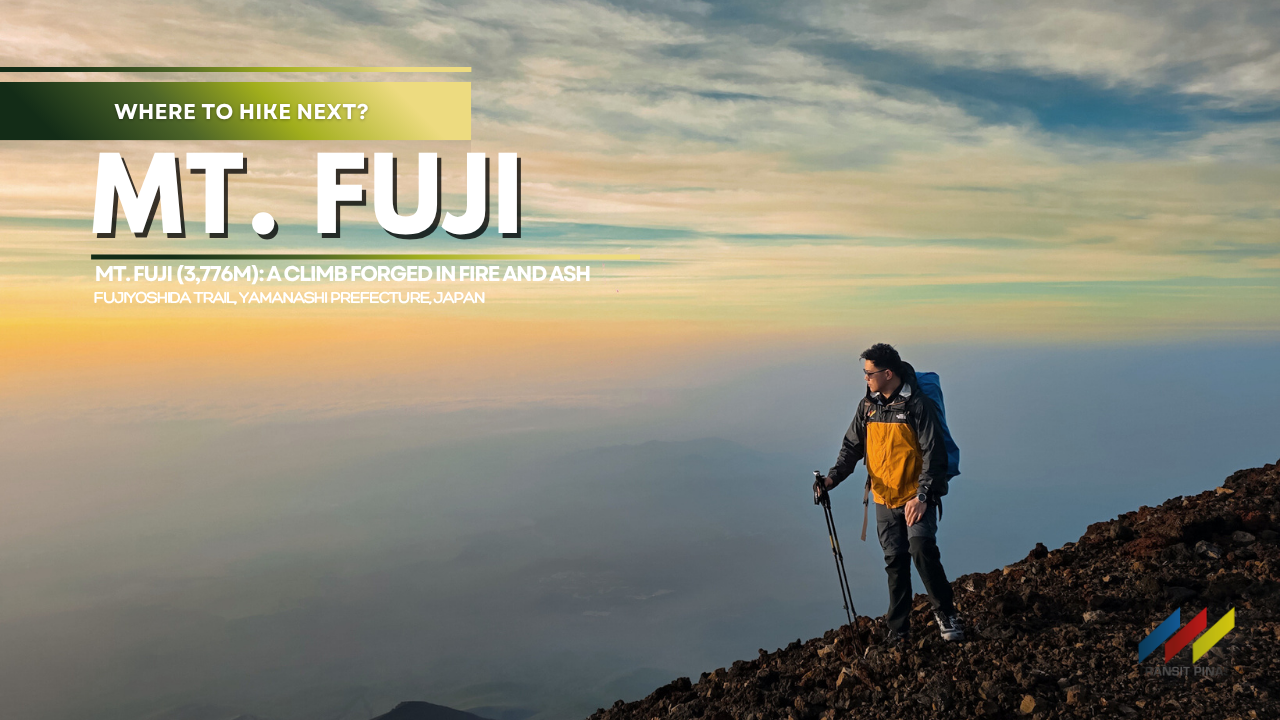
Mount Fuji (3,776m), Japan: A Climb Forged in Fire and Ash
Mt. Fuji, Japan: The mountain I’ve been dreaming of for years now stretches before me. Mt. Fuji’s no longer a distant fantasy but a towering reality. My feet are finally planted on the starting line of the Fujiyoshida Trail, where the path up Fuji-san truly begins.

Beyond this point lies the rooftop of Japan—follow me in this adventure as we climb up the slopes of Japan’s most sacred mountain.

Table of Contents
Fuji-Subaru Line 5th Station
The air at the Fuji-Subaru Line 5th Station is thick with excitement. At 2305m, the world feels vast, and the bustling, almost carnival-like marketplace with its souvenir shops and brightly painted buildings is a vibrant, slightly surreal launching pad. We’ve seen the iconic peak from below, but now, we’re standing on its flank, ready to embrace the giant.


But don’t be fooled by the flat, gently winding path that greets you immediately after you pass the official climbing gate. This first stretch, the prelude to the real climb, is almost deceptive.


The Gentle Deception (5th Station to 6th Station)
For the first hour or so, you’re on a wide, winding path—a gentle, graded track of packed dirt and small stones.


It feels more like a scenic walk than a mountain ascent. Stunted, tenacious trees might still surround you, a few final pockets of greenery clinging to the lower slopes. The sound of fellow hikers’ chatter is loud, energy is high, and the view back down over the clouds is already starting to open up, giving you a glimpse of the world you’re leaving behind.


This segment is the mountain’s warm-up; it’s easy to push the pace, but the wise hiker knows this is the time to acclimate, to settle into a slow, steady rhythm.

Shedding the Forest, Gaining Elevation
Around the 6th Station and the mountain safety center, the illusion of a leisurely hike ends. The separate ascent trail begins, and the path transforms. You leave the last protective shelter of the trees behind, and the vast, raw, volcanic landscape takes over.


The trail here is a distinctive red-brown volcanic scree and sand. It’s wide, yet already steeper, and is marked by long, zigzagging switchbacks carved into the mountainside. Every step is an upward battle against gravity and the slightly loose, shifty footing.


As you trek on, the switchbacks begin to feel like a slow, deliberate march up the mountain’s immense shoulder. The path is well-defined, bordered by ropes and simple wooden posts, but the ground beneath your feet is pure Fuji—a mix of sand and small lava stones.

As you approach the 7th Station area at around 2700 meters (where Hana-goya and Hinode-kan are located), the trail morphs again. The gentle zigzag gives way to a more rugged, rocky climb. The mountainside no longer just slopes; it angles dramatically.
Hinode-kan: A Stone Citadel on Fuji’s Slope
Here, you encounter the famous, almost fortress-like mountain huts, clinging precariously to the volcanic rock like barnacles on a ship.

To reach the entrance of a place like Hinode-kan (at 2720m), we navigated sections that feel less like hiking and more like scrambling up rock faces, sometimes with the aid of fixed ropes or chains bolted into the stone.


The final steps to your rest-stop are a testament to the mountain’s true nature: an increasingly steep, demanding world of dark lava rock and sparse, hardy vegetation. You look down, and the world below is a sprawling canvas of clouds—you’re officially among the high peaks, ready for your well-earned break on the volcanic spine of Japan.

The climb to this point has been a steady, gritty transition from humanity’s familiar comforts to the raw, breathtaking exposure of the sacred mountain.
Steeper Grade Ahead: Hinode-Kan to Haku-un-so
We peeled ourselves out of a quick rest at Hinode-kan, the warm glow of the afternoon sun bid a temporary farewell as clouds gathered on top of us. Upward was the only way, toward our final stop for the night: Hakuunso at the 8th Station.

The moment you leave the 7th Station huts, the climb changes character. Gone are the gentler, zigzagging paths of the earlier stages. This section of the Yoshida Trail throws you straight into an arduous, relentless scramble. The route becomes significantly steeper and rockier, demanding hands-on climbing in certain spots. It’s less of a hike and more of a vertical march that passes through stations of Tomoe-Kan, Toyokan, Taishikan, and Horai-kan.

And that’s where the “lunar landscape” really takes hold. The ground is a uniform, dark, reddish-brown scree and volcanic rock—a shattered, mineral world entirely stripped of vegetation. With the fading light, the vast, desolate slopes of Fuji stretched out above and below, making us feel like early astronauts on a harsh, unforgiving world. There is no shade, just the raw mountain face. It truly felt like traversing a path on the moon.


Under the Cloudburst: A Soaking Scramble on Volcanic Earth
Then came the drama. The weather, as it does so often on Fuji, turned with terrifying speed. In a matter of minutes, the darkening sky was obliterated by a 20-minute cloudburst. The rain was cold, with the wind whipping it sideways, turning the path into a slick, black challenge.

The atmosphere crackled with tension, and then, the main event: bouts of lightning that felt too close for comfort, striking the ground maybe a few hundred feet down, each crack of thunder echoing instantly off the barren mountainside. We were fully immersed in the mountain’s terrifying, raw power.


Haku-un-so (3,200m)
But the sheer focus needed to navigate the slippery rock in the gloom and rain had a strange effect until the heavens opened up once again as if nothing had happened. We were so intently focused on placing our feet, one hand-hold after another, that the 500-meter elevation gain just melted away.


Before we knew it, the welcome sight of the 8th Station’s cluster of mountain huts, culminating in Hakuunso, appeared out of the mist. We were finally there!


The relief was palpable, but the adrenaline had clearly done its job. While I was ready to collapse, some of my friends—riding that final surge of energy and probably still buzzing from the lightning show—barely paused, already talking about the final push to the summit.


A night of rest at Haku-un-so was well-earned, but the true climb, we all knew, still lay ahead. The mountain had given us a warning, and we’d successfully passed its test… for tonight, at least.


Kusushi Shrine’s Prize: A Slow Climb from the Haku-un-so
The silence of Haku-un-so, our hut at the 8th station, was shattered by the staff’s wake-up call at 01:30 AM. It was time. The goal was simple, yet daunting: reach the summit of Mount Fuji for Goraiko, the sunrise.

Stumbling out into the crisp, high-altitude night, we joined the horde—a stream of climbers all sharing the same aspiration. The atmosphere was surreal, a stark contrast between the inky black sky and the countless headlamps bobbing in the distance.


They were tiny, bright pinpricks, collectively painting a magnificent, zigzagging line up the dark canvas of the mountain. It looked like a brilliant, slow-moving river of stars flowing toward the peak.

Our climb began in this ethereal glow. The trail here is a challenging mix of volcanic scree and large, dark rocks, relentless in its zigzagging ascent. We passed the warm, welcoming lights of Tomoe-kan, another beacon of civilization in the dark, and then later, Goraiko-kan, each hut a small milestone conquered.
Chasing the Dawn: The Final Ascent of Mount Fuji
However, the sheer volume of climbers meant that the ascent quickly became a slow-motion shuffle. It was less a climb and more a patient, methodical queue up the mountain. With every pause in the human chain, our bodies cooled, and the cold crept in. It was a constant battle to maintain just enough movement to generate warmth without exhausting ourselves.

Hours blurred together in this rhythm: step, shuffle, stop, shiver, repeat. The air grew thinner, making every deliberate step a small victory. But as we climbed higher, pushing past the 9th station, the dark began to soften. A faint, fiery orange glow was bleeding into the horizon, a promise of the spectacle to come.

The lights of the other climbers, which had been our only view, now started to illuminate the raw, magnificent, volcanic landscape around us. We were nearing the end of our climb, just in time to witness the ultimate reward. The trail was difficult, the pace agonizing, and the cold biting, but the anticipation of the rising sun spurred us on through those final, grueling steps. We were almost there.
Summit Fire: Fuji’s First Kiss of Light
The final steps to the summit of Mt. Fuji were a world unto themselves. After hours of climbing, the trail dissolved into a rugged, dark expanse. It wasn’t a well-defined path anymore, but rather a climb over volcanic rocks and loose scree, illuminated only by the faint glow of headlamps and the distant lights of the stations below. The air was razor-thin and brutally cold—a stark contrast to the effort required to ascend. Every upward heave of our bodies was a testament to sheer will.


Reaching the summit area was less a triumphant step and more a huddled shuffle into a designated viewing spot near the crater rim. The energy was electric, despite the cold. Hundreds of silent figures, cocooned in layers, lined the edge, all eyes fixed on the deepening crimson of the eastern sky.


As the moment arrived and the sun fully peeked over the horizon, a different spectacle than the classic “sea of clouds” unfolded. Instead of dramatic white billows, a vast, pale haze stretched out below us. Yet, there was a profound beauty in this clarity.


The first, intense rays of morning sun were not diffused by clouds but pierced directly through the haze, painting the world in powerful strokes of orange and gold.


It was a raw, magnificent, and utterly unique moment. With the warmth of the sun finally touching our faces, all the aches, the cold, and the exhaustive climb faded. Our Fuji dreams were now realized, standing on Japan’s highest peak as the world woke up beneath us.


Circling the Crater and Kengamine Peak
With the initial emotional climax passed, we turned our attention to the vast, barren crater of Fuji-san. The summit is not just a point, but a massive geological feature to be explored. We embarked on the Ohachi-meguri, the crater-circling trail.


The path is raw, an exposed loop of dark-red and black volcanic cinders that skirts the edge of the enormous, silent caldera.


Our immediate goal was the true apex: Kengamine Peak. This is the highest point in all of Japan, and the path to it is exhilarating. A final, steep scramble known as the “Horse’s Back” ridge, where you cling to chains against the wind, leads you to the weathered monument that marks 3,776 meters. Standing there, looking down into the crater on one side and across the vast landscape on the other, was an unparalleled feeling of being on top of Japan.


Finally, we completed our circuit, returning to the more bustling area of Kusushi Shrine. It felt like re-entering civilization after a moon landing. The vibrant flags, the sounds of chatter, and the small wooden structures were a welcome sight.

It was here, surrounded by the signs of a successful journey, that we paused for a final moment of reflection before starting the long, winding descent—carrying not just our packs, but the weight of an unforgettable sunrise.


A Dance with Scree: Descending Fuji’s Volcanic Embrace
The summit of Mount Fuji—it still feels surreal to even write those words. For so long, it was a fantastical, almost ridiculous item on a mental bucket list, a wild, distant dream. Now, looking down from the peak, watching the sun cast long shadows over the landscape we’d just conquered, the sheer magnitude of it all hit me. We actually did it. We stood on the highest point in Japan.


If the ascent was a slow, deliberate trudge—a meditative, agonizing stair climb—the descent was a strange, exhilarating dance.

The trail down the main routes, a different one from the ascent, is notoriously filled with loose volcanic scree, that fine, gravelly cinder that makes every step forward feel like a half-step back. It was this same unforgiving surface that made the climb tough but enjoyable, demanding a constant, engaging battle with gravity.

But going down? It transformed the trail into a massive, natural slide.
The Real Descent: A Controlled Chaos
We quickly learned the trick: don’t fight the scree; embrace it. Instead of trying to find a solid footing, we learned to lean back, surf the slope, and let our boots sink a few inches into the gravel. The sheer thrill of it was unexpected. We started with careful steps, but soon, as our confidence grew and our legs craved relief from the slow pace, we started running the slopes.


It wasn’t a controlled sprint; it was controlled chaos. Dust clouds erupted around our ankles as we took huge, sliding strides, leaning far back, laughing like mad children. It felt like skiing without the skis, a full-body commitment to a controlled fall. Every hundred feet we descended felt like a reward, a swift, dusty compensation for the hours of upward grind.


Reflections on a Wild Dream
The physical act of running the scree became a perfect metaphor for the whole journey. Sometimes, the hardest path forward is the one that requires you to let go of control and trust the process—even if that process involves plunging your foot into a pile of loose rock.

As we rocketed down the mountain, my mind kept drifting back to that “wild dream” phase. The initial hesitation, the feeling that I wasn’t “adventurous enough,” or “fit enough.” Fuji, in its stoic beauty, had forced us to prove that those limitations were only in our heads.

In this climb, I have realized that the summit is a moment, but the journey is the triumph. The greatest pride wasn’t standing at the top; it was in the consistency of putting one foot in front of the other for hours on end, even when the air was thin and the path was brutal.

What other “wild dreams” have I discounted simply because they seem too big or too difficult? If I can stand here, dusty, exhausted, and utterly fulfilled, after a climb that was once an impossible fantasy, what else is possible? The mountain teaches you that belief is the first step of the climb.

Sayonara, Fuji-san
The last stretch was a gentler path, the gravel giving way to packed earth. We walked side-by-side, silent for a long time, coated in a fine layer of reddish-brown dust that felt like a badge of honor. The mountain was behind us, the dream achieved, and our feet, though sore, carried us forward with a new, quiet confidence.


It was more than just a hike; it was the definitive proof that the scariest, most ridiculous dreams are often the ones worth pursuing with everything you have.

What’s the next mountain, literal or metaphorical, on your list?
Arigatou gozaimasu, Fuji-san!
Mount Fuji (3776m), Japan: A Climb Forged in Fire and Ash
 Updated October 05, 2025

